

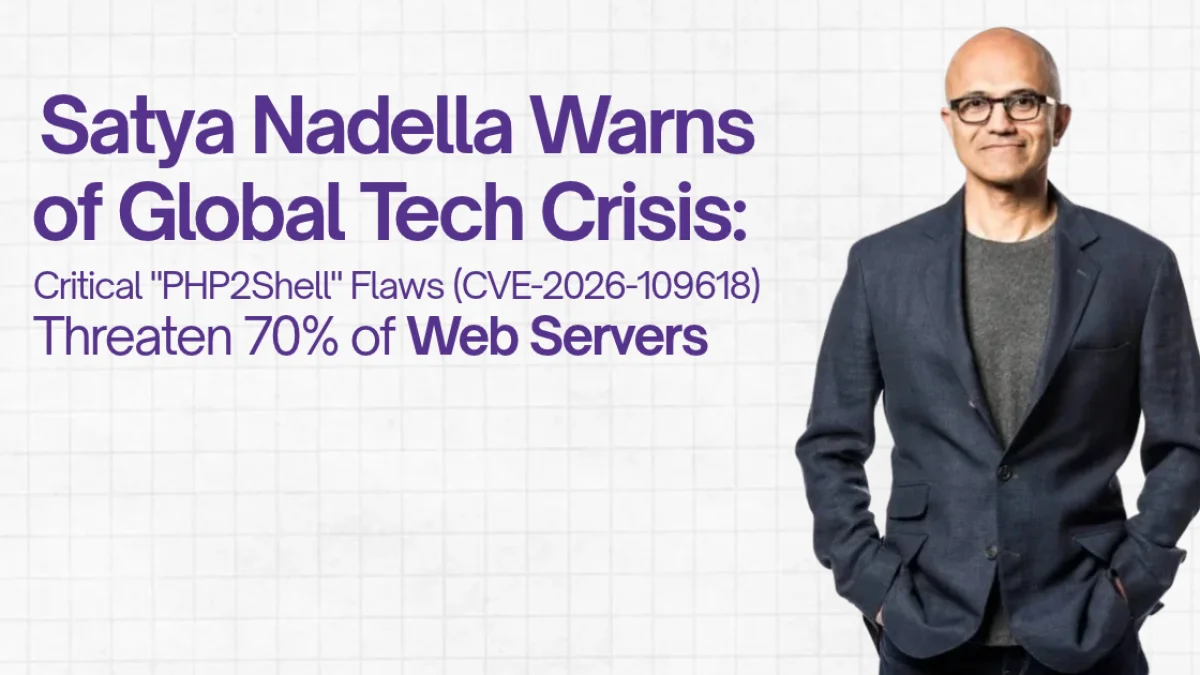
In an unprecedented alert sending shockwaves across global IT infrastructure, Microsoft CEO Satya Nadella has publicly warned of a massive cybersecurity scramble following the disclosure of two critical zero-day vulnerabilities in the core PHP programming language.
Speaking at a major technology summit in Germany, Nadella underscored the sheer gravity of the incident: "I've not seen anything like this in a long, long time. It was a long day and a long night, I know, for all the IT and security folks."
The vulnerabilities, collectively dubbed "PHP2Shell" by cybersecurity firm Wiz Research, have forced emergency patching across global cloud providers, web hosts, financial systems, and municipal infrastructure worldwide.
What is the "PHP2Shell" Crisis? (CVE-2026-109618 & CVE-2026-109619)
Discovered by Wiz Research in collaboration with Calif and OpenAI, the vulnerabilities track as CVE-2026-109618 and CVE-2026-109619, carrying a near-maximum CVSS v4.0 severity rating of 9.2.
Unlike standard application-level bugs, PHP2Shell resides deep inside the core memory management architecture of the PHP engine itself, spanning versions PHP 5.4 all the way to PHP 8.5. Because PHP powers over 70% of all websites on the internet—including WordPress, Drupal, Joomla, and enterprise web applications—the attack surface is virtually limitless.
Core Vulnerability Snapshot
- Vulnerability Name: PHP2Shell
- CVE Identifiers: CVE-2026-109618 & CVE-2026-109619
- Severity: 9.2 Critical (Remote Code Execution / Memory Disclosure)
- Affected Scope: PHP Core 5.4 through 8.5 (~70% of global web servers)
- Discovery Vector: AI-assisted low-level memory corruption analysis (Wiz + OpenAI)
- Attack Requirement: None (Unauthenticated remote HTTP request)
How the Exploit Works: Low-Level Memory Mismanagement
The root cause lies in how PHP handles HTTP request initialization, error management, and out-of-memory (OOM) states. Under specific conditions, when an attacker sends specially crafted HTTP payload sequences, the PHP process mishandles internal request cleanup:
- Leftover Global Memory State: Residual state variables persist across fastcgi/FPM worker threads instead of being cleanly purged.
- Process Memory Exposure: The attacker can force an OOM condition or specific memory offset to read sensitive server memory (database credentials, private keys, session tokens).
- Arbitrary Remote Code Execution (RCE): In worst-case configurations, chained memory corruption allows the remote attacker to inject arbitrary shell commands directly into the underlying operating system with the privileges of the web server (e.g.,
www-dataornobody).
Version Impact & Emergency Patch Matrix
Security teams and system administrators should immediately review their installed PHP runtime versions against this matrix:
| PHP Branch | Status | Remediation Release |
|---|---|---|
| PHP 5.4 – 8.0 | End of Life (Vulnerable) | Immediate upgrade to 8.2+ required or OS backport patch |
| PHP 8.1 | Security Only (Vulnerable) | Apply OS vendor patch or upgrade to PHP 8.2.26 / 8.3.14 |
| PHP 8.2 | Active Support | Upgrade immediately to PHP 8.2.26+ |
| PHP 8.3 | Active Support | Upgrade immediately to PHP 8.3.14+ |
Emergency Action Plan: How to Secure Your Servers Immediately
Every webmaster, sysadmin, and developer hosting PHP or WordPress applications must execute the following remediation steps without delay:
1. Update Server PHP Packages (Ubuntu / Debian)
sudo apt update
sudo apt --only-upgrade install php8.2 php8.2-fpm php8.2-cli
sudo systemctl restart php8.2-fpm
sudo systemctl restart nginx # or apache2
2. Update via cPanel / WHM / LiteSpeed Web Server
- Log in to WHM / cPanel as root.
- Navigate to EasyApache 4.
- Run the latest system provision update to pull the newly compiled PHP 8.2.26 / 8.3.14 patch builds released by CloudLinux / cPanel upstream.
- Restart LiteSpeed (
service lsws restart) to flush cached worker pools.
3. Temporary Mitigation via Web Application Firewall (WAF)
If you manage legacy servers that cannot be immediately updated, enforce strict payload boundary checks at your Cloudflare or Reverse Proxy edge layer:
- Block malformed multipart/form-data request streams exceeding 16MB unless strictly verified.
Disable non-essential dangerous functions in
php.ini:disable_functions = exec,passthru,shell_exec,system,proc_open,popen- Enforce strict memory limits (
memory_limit = 256M) to prevent OOM fragmentation attacks.
Frequently Asked Questions (FAQ)
Is WordPress vulnerable to PHP2Shell?
Yes. Because WordPress core runs on PHP, any WordPress instance operating on an unpatched PHP version is susceptible to exploitation if attackers trigger the underlying memory corruption vector.
Can cloud hosts like Hostinger, AWS, or Cloudflare protect my site?
Major cloud providers and managed hosts have begun rolling out automated upstream kernel and PHP binary patches. However, self-managed VPS, dedicated servers, and legacy unmanaged hosting accounts require manual package updates from administrators.
Why did Satya Nadella comment on PHP?
Microsoft operates thousands of cloud services, Azure app runtimes, and developer tooling ecosystems that interface with PHP. Nadella's statement underscores the growing systemic risk where AI-driven vulnerability discovery tools are uncovering decades-old foundational bugs faster than legacy software ecosystems can manually patch them.