
Google has officially launched Universal Cart across the United States in both Google Search (including Search AI Mode) and the Gemini mobile and web apps. Announced by Suresh Ganapathy, Senior Director of Product Management for Consumer Shopping at Google, the new feature unifies fragmented retail carts, screenshots, and open browser tabs into an intelligent, centralized shopping hub powered by Google's massive 60+ billion-item Shopping Graph.
As digital commerce pivots toward autonomous AI agents, Google's strategy focuses on practical consumer utility: giving shoppers full visibility over pricing trends, promo codes, and payment rewards without forcing them to manually track dozens of store websites ahead of Black Friday and the seasonal holidays.
What is Google's Universal Cart?
First previewed at Google I/O in May, Universal Cart serves as an interoperable shopping basket across the entire Google ecosystem. When browsing products via conversational prompts in the Gemini app or exploring comparative buying guides in Google Search's AI Mode, users can add items directly to a single cart regardless of which merchant sells them.
Universal Cart operates on top of the Universal Commerce Protocol (UCP), an underlying technical architecture that bridges search queries, retailer product feeds, and digital payment gateways into a standardized transaction layer.
The 4 Core Pillars of Google Universal Cart
1. Unified Cross-Merchant Basket
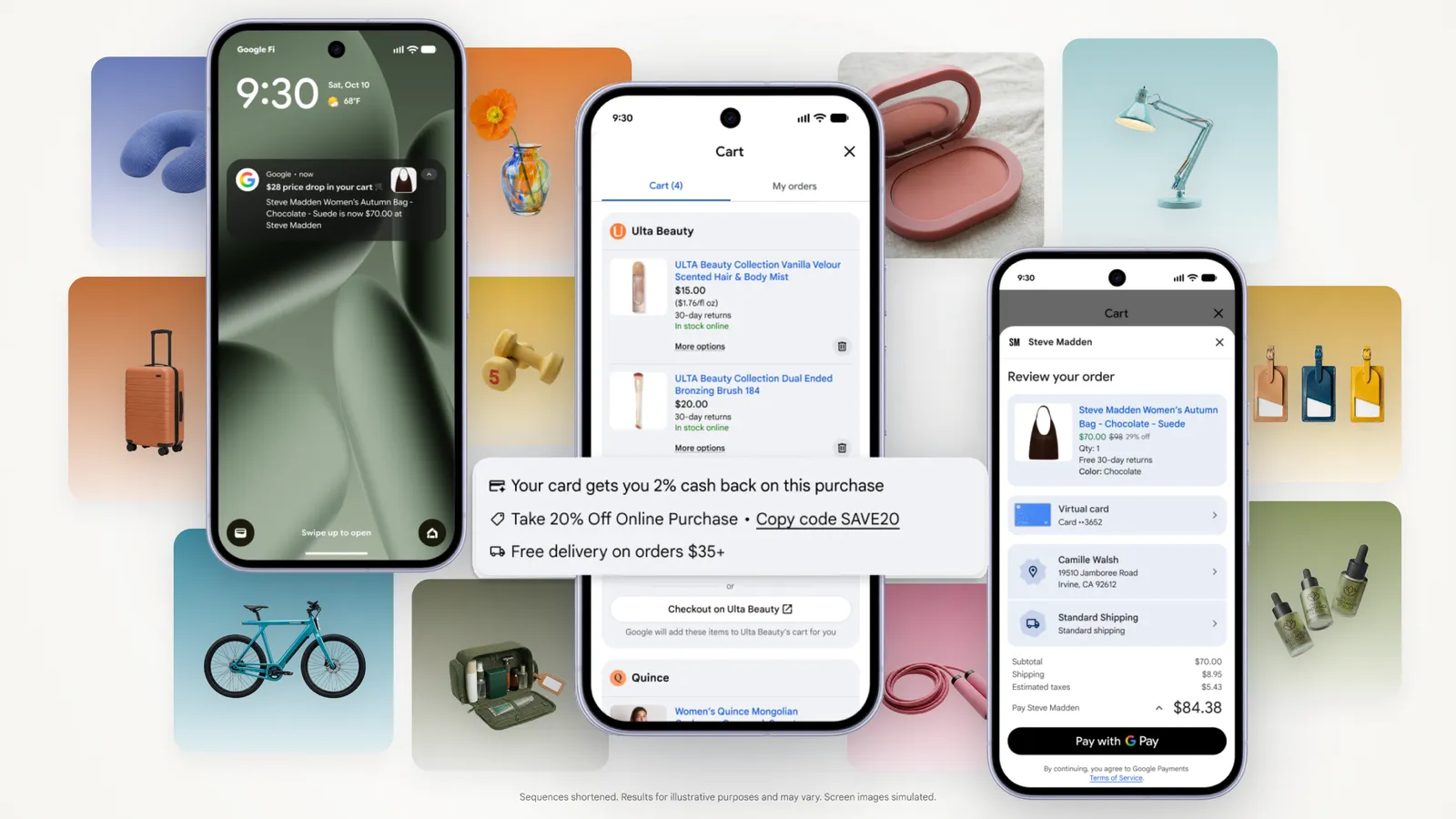
Shoppers no longer need dozens of open browser tabs or screenshots to compare items. A user can save a handbag from Steve Madden while searching in AI Mode, add a sweater from Quince inside the Gemini app, and append cosmetics from Ulta Beauty later in the day. All products remain synced and accessible across desktop and mobile devices.
2. Proactive Telemetry: Price Drops & Restock Alerts
Leveraging real-time telemetry from Google's Shopping Graph—which refreshes data across more than 60 billion product listings continually—Universal Cart operates autonomously in the background. It sends push notifications and alerts when saved products drop in price or when out-of-stock sizes and variants return to merchant inventory.
3. AI-Driven Hidden Savings & Wallet Rewards
Integrated deeply with Google Wallet, Universal Cart evaluates the user's saved payment methods. The system's reasoning models analyze specific credit card perks (such as points accelerators, travel points, or cashback tiers) to recommend the most cost-effective card for each purchase. Additionally, it scans and surfaces verified merchant promo codes directly in the cart drawer.
4. Flexible, Merchant-First Checkout
When ready to purchase, shoppers are given two distinct, frictionless options:
- Direct Google Pay Checkout: Complete purchases in a few taps directly within the Google interface for participating launch partners.
- 1-Click Merchant Cart Transfer: Transfer the entire saved basket directly into the retailer's native checkout page.
Flagship launch retailers include Nike, Target, Walmart, Sephora, Ulta Beauty, Wayfair, and tens of thousands of independent Shopify storefronts. Crucially, Google emphasized that retailers remain the seller of record, managing order fulfillment, customer support, and direct transaction receipts.
Feature Overview: Universal Cart Technical Architecture
| Capability | Traditional E-Commerce Search | Google Universal Cart (AI Agentic) |
|---|---|---|
| Cart Storage | Siloed per retailer domain; lost upon clearing cookies. | Persistent cloud basket synced across Search, Gemini, and Google Account. |
| Inventory Monitoring | Manual page refreshes by the consumer. | Autonomous telemetry powered by the 60B+ Shopping Graph. |
| Payment Intelligence | Generic autofill; user calculates card benefits. | Google Wallet AI analyzes points and perks per merchant. |
| Checkout Protocol | Redirect to merchant cart URL with affiliate parameters. | Universal Commerce Protocol (UCP) with Google Pay or direct cart handoff. |
"As we build for the future of commerce, our focus spans two fronts: unlocking agentic capabilities that act on your behalf, and designing practical tools that give shoppers confidence and control."
— Suresh Ganapathy, Senior Director of Product Management, Consumer Shopping at Google
Strategic Implications for E-Commerce Webmasters & SEOs
The rollout of Universal Cart signals a major shift in how search algorithms index, rank, and convert commercial web traffic:
- Merchant Center Feed Freshness is Mandatory: Real-time pricing and stock telemetry depend directly on Content API and Google Merchant Center updates. Stale inventory data will lead to disqualified cart entries.
- Structured Data Integrity (Schema.org): E-commerce stores must maintain comprehensive
Product,Offer,priceValidUntil, andMerchantReturnPolicymicrodata to ensure eligibility for AI agent recommendations. - Sub-500ms Server Response (TTFB): As Google and Gemini query merchant availability in real time, high server latency during peak shopping spikes can cause AI agents to default to faster competitors.