

Google Search Central Documentation Update: Crawl Rate Reduction • Emergency Throttling & Retry-After Semantics
Google Search Central has officially refreshed its technical documentation regarding how webmasters, system administrators, and DevOps engineers can reduce Googlebot crawl rates. In an important structural revision to the "Urgently reduce crawler traffic (for emergencies)" section, Google now explicitly documents and provides code examples for implementing the Retry-After HTTP response header (defined under RFC 9110 HTTP Semantics) in combination with 503 Service Unavailable and 429 Too Many Requests status codes.
The Technical Context: Why Crawl Rate Emergencies Occur
Under normal operating conditions, Googlebot automatically calibrates its crawling speed using adaptive capacity algorithms based on server response latency, Time to First Byte (TTFB), and host error rates. However, during unplanned infrastructure stress—such as unexpected traffic surges, internal database deadlocks, unoptimized faceted navigation spider traps, or maintenance deployments—aggressive crawler concurrency can quickly exhaust server CPU and memory pools.
Historically, many site owners mistakenly added the unofficial crawl-delay directive to their robots.txt file in an effort to slow down Googlebot. Google has repeatedly reiterated that Googlebot completely ignores crawl-delay in robots.txt. Instead, search crawlers rely strictly on standard HTTP protocol signals.
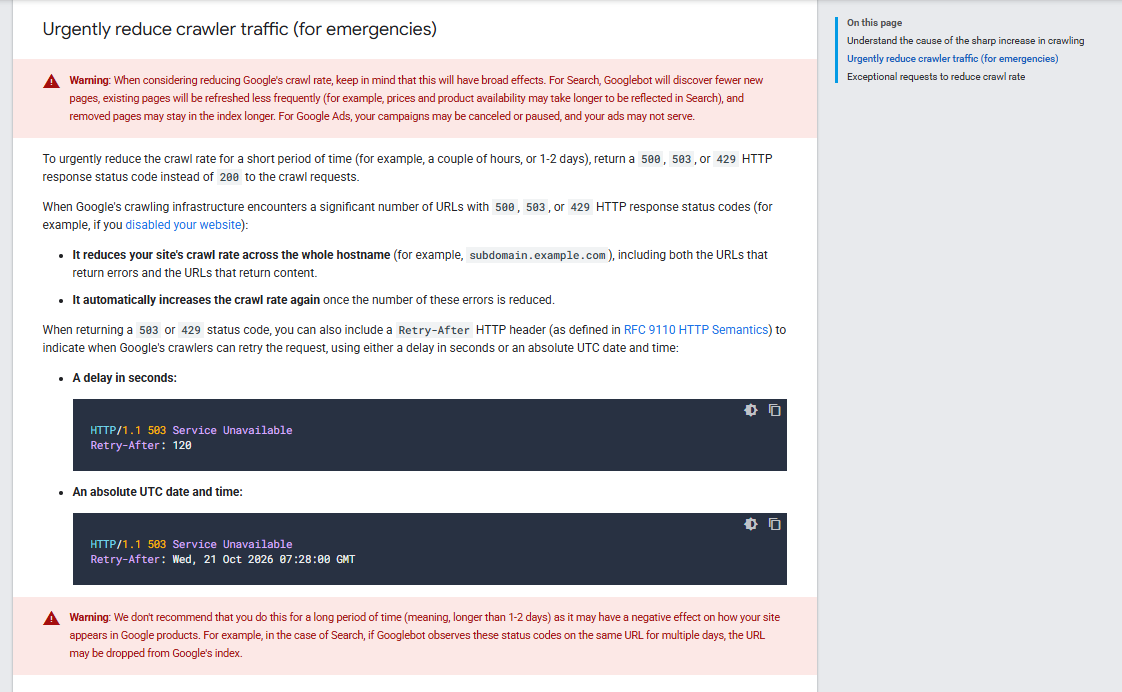
"Support for the Retry-After HTTP header is not new (it was already documented in Temporarily pause or disable a website), and adding it directly to the crawl rate reduction guide makes it easier to find and understand when urgently reducing crawler traffic." — Google Search Central Official Documentation Update
How Retry-After Works with 503 & 429 Status Codes
When your web server or reverse proxy is overwhelmed, returning an HTTP 503 Service Unavailable or 429 Too Many Requests signals to Googlebot that the server is temporarily unable to handle incoming requests. By including the Retry-After header, you provide an explicit instruction informing Google's crawlers exactly when it is safe to resume fetching pages.
1. Delay in Seconds (Relative Duration)
You can specify the number of seconds Googlebot should pause before re-attempting the crawl. For example, to request a 1-hour delay:
HTTP/1.1 503 Service Unavailable Content-Type: text/html; charset=UTF-8 Retry-After: 3600
2. Absolute UTC Timestamp (HTTP Date Format)
Alternatively, you can provide an exact RFC 9110 compliant UTC datetime string indicating when maintenance is scheduled to conclude:
HTTP/1.1 503 Service Unavailable Content-Type: text/html; charset=UTF-8 Retry-After: Wed, 21 Oct 2026 07:28:00 GMT
Critical Webmaster & SEO Caveats
Avoid Multi-Day Outages: While Googlebot honors Retry-After for short-term maintenance or temporary overload spikes, maintaining a 503 status code for more than 48 to 72 hours poses severe SEO risks. If URLs remain unreachable over consecutive crawl passes, Googlebot will gradually de-index them from live search results.
Never Pair Retry-After with HTTP 200: The Retry-After header is semantically valid only when paired with error status codes like 503 or 429. Adding it to a successful 200 OK response will be disregarded by search engine indexers.
Solve the Root Architectural Cause: If your server consistently struggles under normal Googlebot crawls, do not rely on 503 throttling as a permanent band-aid. Instead, optimize server TTFB, activate Redis or Varnish page caching, and eliminate redirect chains and spider traps.
Practical Web Server Configuration Patterns
Nginx Configuration Example
# Urgent crawl throttling during server maintenance error_page 503 @maintenance; location / { if (-f $document_root/maintenance.lock) { return 503; } try_files $uri $uri/ /index.php?$query_string; } location @maintenance { add_header Retry-After 7200 always; add_header Content-Type text/html; return 503 "
503 Service Unavailable
Undergoing scheduled maintenance. Please retry in 2 hours.
"; }
Research Lab Takeaways & Crawl Telemetry
This technical SEO briefing is published by the gtmetrix.in Performance & SEO Research Lab. Google's explicit inclusion of Retry-After in crawl reduction documentation gives engineering teams a standardized, safe protocol for emergency bot management. To verify your server's TTFB under load and prevent crawler bottlenecks, run an audit using our free gtmetrix.in Speed Test Engine and inspect internal hops with the Redirect Chain Tracer.