

Google Search Central Official Feature Rollout: Performance Report Filters • Multi-Country & Device Aggregation
Google Search Central has officially announced a long-awaited upgrade to Google Search Console (GSC) Performance reports: digital teams, international SEOs, and enterprise webmasters can now select multiple countries and device types simultaneously to analyze their combined organic search traffic patterns in a single unified view.
The Historical Problem: Single-Country Filter Limitations
Until today, Google Search Console's Performance dashboard strictly limited geographic filtering to an isolated 1:1 model. Webmasters could either filter by a single individual country or compare two individual countries against each other.
For multi-regional brands, global e-commerce stores, and publishers operating across regional trade blocs—such as the European Union (EU), DACH (Germany, Austria, Switzerland), LATAM (Brazil, Mexico, Colombia), or APAC—this limitation created significant operational friction:
- Manual Spreadsheet Stitching: SEO teams had to manually export separate CSV files for every individual market and merge clicks, impressions, and CTR inside Excel or Google Sheets.
- API & BigQuery Overhead: Enterprise brands frequently had to write custom Python scripts or configure Google BigQuery data pipelines through the Search Console Bulk Data Export simply to aggregate regional traffic.
- Lack of Real-Time Regional Visibility: Diagnosing ranking volatility across a shared language cluster (e.g. Spanish-speaking Latin America or English-speaking Commonwealth nations) in real time was virtually impossible inside the native GSC interface.
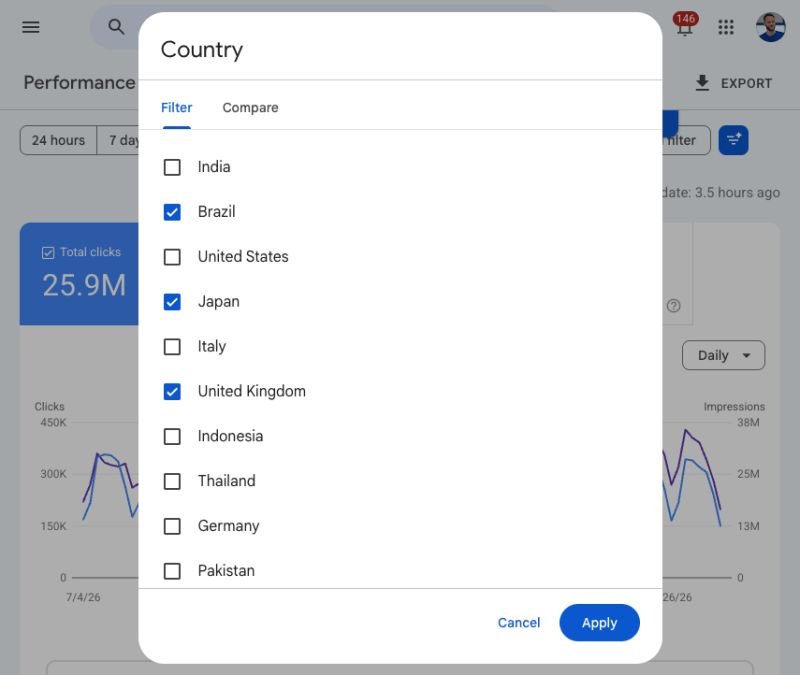
Figure 1: Official Google Search Central announcement showcasing multi-select checkboxes inside the Search Console Country filter dialog.
"Today we're updating the Search Console performance report filters to make it easier for you to analyze traffic patterns across different countries and devices. If you operate in multiple countries, you can now view their combined Google Search traffic." — Google Search Central Official Announcement
Core Features of the New Multi-Select Filter Modal
The new interface introduces intuitive checkbox selection directly into the primary Performance filters toolbar:
- Multi-Select Inclusion Checkboxes: Webmasters can check as many individual countries as needed (for example: Brazil, Japan, and the United Kingdom) without losing aggregated chart telemetry.
- Real-Time Combined Aggregation: The top performance cards (Total Clicks, Total Impressions, Average CTR, and Average Position) dynamically recalibrate to represent the combined organic traffic across all selected countries.
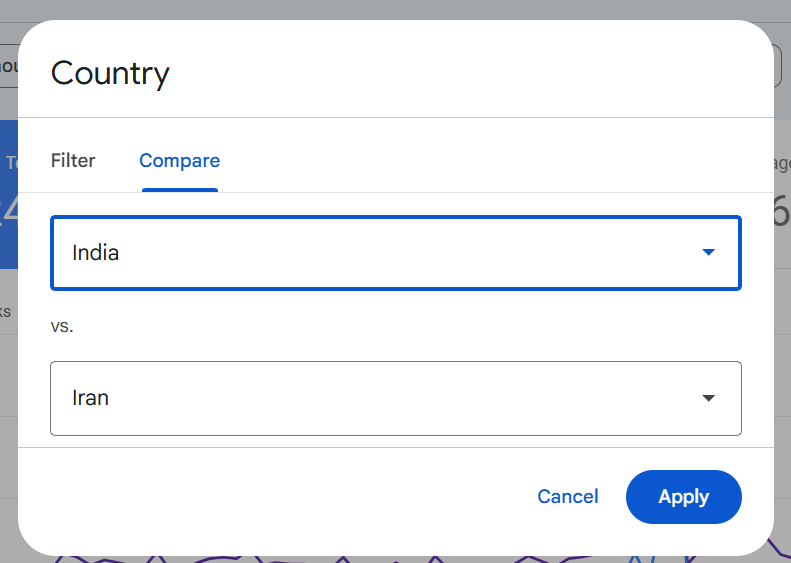
Dedicated Filter vs. Compare Modes: The modal preserves a clean two-tab architecture: Filter (for multi-select combined pooling) and Compare (for head-to-head performance comparisons).
- Multi-Device Filtering: The same multi-select functionality applies to the Device filter, enabling teams to aggregate Mobile and Tablet traffic together while excluding Desktop, or vice versa.
4 Strategic Use Cases for International & Technical SEOs
1. Economic & Fulfillment Bloc Tracking
International e-commerce platforms can now construct filter presets matching their actual supply chain and warehouse footprints. If your international logistics hub ships exclusively to North America (United States, Canada, Mexico), you can monitor your combined organic search demand without noise from non-serviced regions.
2. Regional CDN Caching & Edge Latency Correlation
Physical server distance and regional network routing have a direct impact on Time to First Byte (TTFB) and Core Web Vitals (Largest Contentful Paint & Interaction to Next Paint). By grouping traffic from regions served by specific CDN edge clusters (e.g. South America or Southeast Asia), DevOps engineers can correlate regional search impression volume with field performance metrics.
3. Tier 1 High-Value Lead Segmentation for B2B SaaS
B2B enterprise applications often derive 80% of pipeline revenue from a select tier of English-speaking markets (US, UK, Canada, Australia). Combining these countries allows marketing leaders to analyze branded organic CTR and high-intent query visibility without skew from high-impression, low-conversion global search traffic.
4. Localized Algorithm Volatility Diagnostics
When Google initiates core algorithm updates or spam classifier rollouts, data center propagation and localized language testing often cause fluctuations in specific territories before others. Multi-country filtering allows analysts to isolate affected geographic clusters and distinguish regional classifier tests from global site architecture issues.
How to Access the New Filters in Google Search Console
- Navigate to Google Search Console and select your verified domain property.
- In the left sidebar, click on Performance .
- At the top of the report, click on the + Add filter button and choose Country.
- In the popup modal, check the boxes next to the countries you wish to combine and click Apply.
- The dashboard and data tables below will automatically update to reflect combined clicks, impressions, and average position across your selected markets.
Research Lab Takeaways & Performance Optimization
This technical briefing is published by the gtmetrix.in Performance & SEO Research Lab. Combining multi-country traffic in Search Console is a major diagnostic leap for digital teams. As you evaluate your international traffic clusters, ensure your global edge architecture delivers sub-100ms TTFB and perfect Core Web Vitals across every market using our free gtmetrix.in Speed Test Engine and Redirect Chain Tracer.